|

The following extract looks at the
short life of Hastings branch, and then Martins Bank Magazine pays the
branch a visit about a year after it is first opened. Finally we have what
turns out to be quite a lavish publicity article from the Brighton Evening
Argus, which welcomes the new branch and its Manager Mr E J Morris, to the
town of Hastings…

Martins
Bank in Hastings…

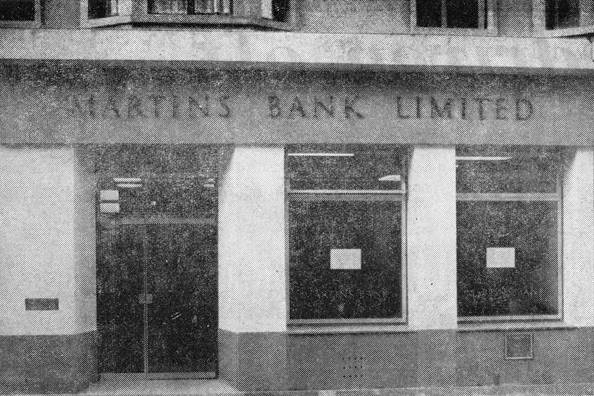
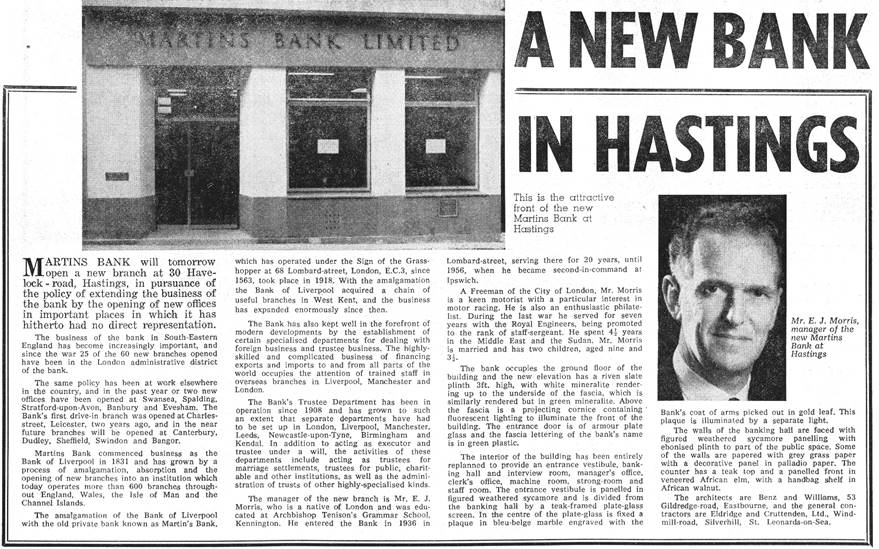
  {Martins’ Branch in Hastings was opened at 30 Havelock Road in May
1961 under the management of Mr Eric Morris with Mr Norman Frake as his
second man. This team stayed together for five years, during which time the
business expanded with the Branch consolidating its representation in the
town. The Branch was situated in the middle of the commercial centre of
Hastings and is in fact the only Martins Bank premises in the county to
retain a link with the banking industry, as the premises are now occupied
by a Branch of the Trustee Savings Bank. The Branch was soon closed after
the merger with Mr Morris moving to Barclays St Leonards on the 1st January
1970 and the office itself finally closing on the 6th April 1970. The
majority of the business accounts moved to St Leonards and the remaining
accounts were taken over by Hastings office}. {Martins’ Branch in Hastings was opened at 30 Havelock Road in May
1961 under the management of Mr Eric Morris with Mr Norman Frake as his
second man. This team stayed together for five years, during which time the
business expanded with the Branch consolidating its representation in the
town. The Branch was situated in the middle of the commercial centre of
Hastings and is in fact the only Martins Bank premises in the county to
retain a link with the banking industry, as the premises are now occupied
by a Branch of the Trustee Savings Bank. The Branch was soon closed after
the merger with Mr Morris moving to Barclays St Leonards on the 1st January
1970 and the office itself finally closing on the 6th April 1970. The
majority of the business accounts moved to St Leonards and the remaining
accounts were taken over by Hastings office}.

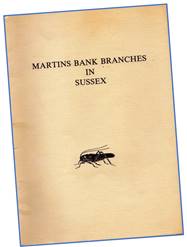
ABRIDGED FROM “MARTINS BANK BRANCHES
IN SUSSEX” © A F HILL 1984
Courtesy W N Townson Bequest
(Martins Bank Archive Collections)
Stylish Modernity…
(with maybe still just a whiff of the 1950s…)

 One cannot visit Hastings for
the first time without being conscious of being near the scene of tremendous
events in our island history. It was not far from here that William the
Conqueror came ashore and made his way inland some six miles to encounter
the hastily summoned forces of Harold on Senlac hill at Battle. The noble
ruins of Battle Abbey on the crown of the hill, part of which have been
restored and are in use as a girls' public school, are a fitting reminder
of these events of long ago. In Hastings itself, however, the only visible
link with the past is the ruined castle, the first Norman fort to be built
by William after the Conquest, from which a fine view of the town is
obtained. Although a community of some 66,000 people, Hastings gives the
impression of being a place which is just beginning to recover from a
period of depression. One cannot visit Hastings for
the first time without being conscious of being near the scene of tremendous
events in our island history. It was not far from here that William the
Conqueror came ashore and made his way inland some six miles to encounter
the hastily summoned forces of Harold on Senlac hill at Battle. The noble
ruins of Battle Abbey on the crown of the hill, part of which have been
restored and are in use as a girls' public school, are a fitting reminder
of these events of long ago. In Hastings itself, however, the only visible
link with the past is the ruined castle, the first Norman fort to be built
by William after the Conquest, from which a fine view of the town is
obtained. Although a community of some 66,000 people, Hastings gives the
impression of being a place which is just beginning to recover from a
period of depression.
 The front is shabby and
nondescript but things improve rapidly in the direction of St. Leonards and
a large block of new flats which dominates the scene at that end will be
offset by a large new hotel which is to be built in Hastings itself,
planned to rise to over 20 floors. It will provide a focal point just as
Blackpool Tower does on the Lancashire coast.Our branch at Hastings was
planned some years ago and, as soon as a suitable site became available we
started to build and the new branch is yet another fine specimen of modern
bank architecture, with beautiful woodwork, panel lighting and tasteful
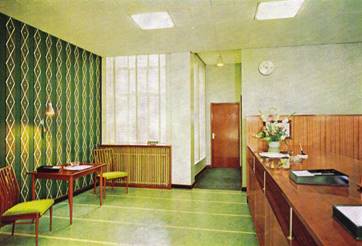
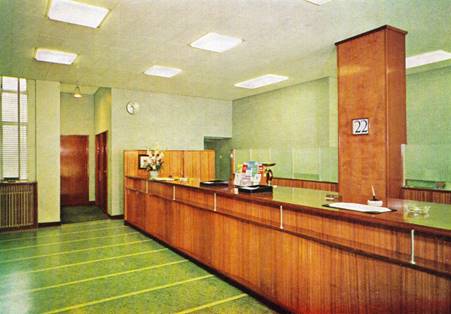
fittings. The front is shabby and
nondescript but things improve rapidly in the direction of St. Leonards and
a large block of new flats which dominates the scene at that end will be
offset by a large new hotel which is to be built in Hastings itself,
planned to rise to over 20 floors. It will provide a focal point just as
Blackpool Tower does on the Lancashire coast.Our branch at Hastings was
planned some years ago and, as soon as a suitable site became available we
started to build and the new branch is yet another fine specimen of modern
bank architecture, with beautiful woodwork, panel lighting and tasteful
fittings.

An innovation which ought to be
very popular with the ladies is a space immediately underneath the counter
top for handbags or shopping bags, while the counter top is left free for
the transaction of banking business. Another noteworthy feature is the
glass entrance door on which is mounted a large coloured replica of the
Bank's coat of arms. It is unusual to find a new branch
staffed entirely by men from the District in which it is situated, but this
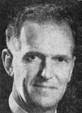
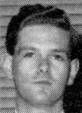
is true of Hastings. The Manager, Mr. E. J. Morris, entered the Bank in
1936 at 68, Lombard Street. He served with H.M. Forces from 1939-1946,
afterwards returning to Lombard Street. He went to Ipswich in 1956 and
there he acted as second-in-command until he was given the chance to open
the new branch at Hastings.
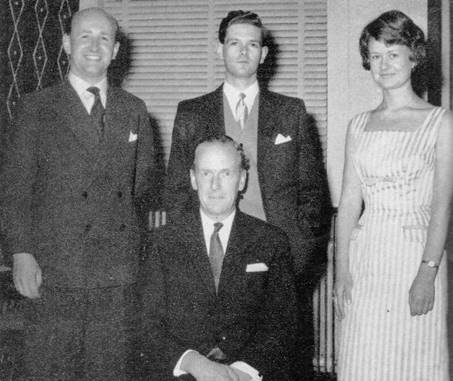 He hasn't got the easiest of
jobs as there is very little industry and the place is a fairly typical
seaside town with a permanent population of retired people and the usual
holiday influx. There is business,
however, and it will be Mr. Morris's task to see that we get our fair share
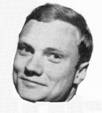
of it. To help him he has Mr. N. R.
Frake as second-in-command. Mr. Frake is another Lombard Street man who
started his career there in 1951 and reached Hastings via Bexhill,
Tunbridge Wells, Moorgate and District Office Relief Staff. He is well known
in the district as a tenor and, as a keen member of two operatic societies,
appears in several shows each year. He also fulfils singing engagements in
various places, so that his identification with Martins Bank ought to help
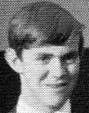
the new branch. The third man is Mr. C. J. Lumley, whose father is on the
staff at Bexhill. He entered the Bank at Kingsway in 1958 and has also
served on the Relief Staff. The ladies are represented by Miss P. M.
Eldridge who entered the Bank as a trainee at Bexhill in 1960. Miss Eldridge
is a capable young lady and from her photo (below) you will not be
surprised to learn that she is interested in modelling for photographic
portraiture. We visited the branch on Monday, July 17th, and we had the
pleasure of entertaining Mr. and Mrs. Morris to lunch before leaving for
Bexhill. He hasn't got the easiest of
jobs as there is very little industry and the place is a fairly typical
seaside town with a permanent population of retired people and the usual
holiday influx. There is business,
however, and it will be Mr. Morris's task to see that we get our fair share
of it. To help him he has Mr. N. R.
Frake as second-in-command. Mr. Frake is another Lombard Street man who
started his career there in 1951 and reached Hastings via Bexhill,
Tunbridge Wells, Moorgate and District Office Relief Staff. He is well known
in the district as a tenor and, as a keen member of two operatic societies,
appears in several shows each year. He also fulfils singing engagements in
various places, so that his identification with Martins Bank ought to help
the new branch. The third man is Mr. C. J. Lumley, whose father is on the
staff at Bexhill. He entered the Bank at Kingsway in 1958 and has also
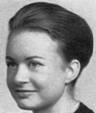
served on the Relief Staff. The ladies are represented by Miss P. M.
Eldridge who entered the Bank as a trainee at Bexhill in 1960. Miss Eldridge
is a capable young lady and from her photo (below) you will not be
surprised to learn that she is interested in modelling for photographic
portraiture. We visited the branch on Monday, July 17th, and we had the
pleasure of entertaining Mr. and Mrs. Morris to lunch before leaving for
Bexhill.

|