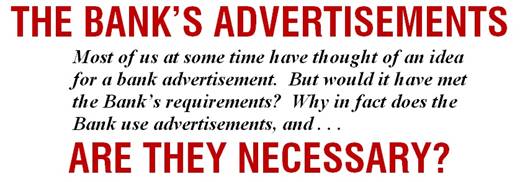
|

In 1965 the first of the more radical changes to Martins’ advertising
begins to be noticed. Beryl Evans, the first appointed female member of staff
in the history of the Bank is at the helm of Advertising Department, and it
shows - The young, carefree and most
importantly WAGE-EARNING girl clutching a bundle of Pound notes, the lady jetting off on holiday
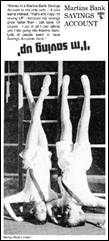
with a man trying to get her luggage into the car, even two “upside down”
schoolgirls talking about savings, are all causing a stir. This leads to people from the (shall we
say) more traditional parts of society to question the value of spending so
much money on what appear to be a few pictures, and even fewer words. In an attempt to convince staff of the
power of this type of advertising, Martins Bank Magazine publishes the
feature below, and poses the question:
|
|

 before seeking to answer this
question it is well to consider the purposes of advertising in general. An
advertiser may wish to promote or increase his business or he may wish to
make an announcement to the public. He may achieve the former by making his
name more widely known or by persuading the public that his product is as
good as if not better than that of his competitors. Either way he hopes to
obtain new business and to maintain the confidence of existing customers. An
announcement will aim to tell people about a new product, a new service, a
change of address, the opening of new premises, the beginning of a new
venture. Before the last war the only
bank advertisements comprised the display of half-yearly balance sheets and
occasional support for certain professional journals. In the last decade the
banks have become increasingly advertising-conscious, realising that a potential
market for new business exists among those not previously banking-minded but
who are now enjoying increased incomes. before seeking to answer this
question it is well to consider the purposes of advertising in general. An
advertiser may wish to promote or increase his business or he may wish to
make an announcement to the public. He may achieve the former by making his
name more widely known or by persuading the public that his product is as
good as if not better than that of his competitors. Either way he hopes to
obtain new business and to maintain the confidence of existing customers. An
announcement will aim to tell people about a new product, a new service, a
change of address, the opening of new premises, the beginning of a new
venture. Before the last war the only
bank advertisements comprised the display of half-yearly balance sheets and
occasional support for certain professional journals. In the last decade the
banks have become increasingly advertising-conscious, realising that a potential
market for new business exists among those not previously banking-minded but
who are now enjoying increased incomes.
 Because
it is harder to sell a service than a product bank advertising poses its own
problems. In particular there is the need of the banks to popularise themselves
in order to attract this vast new market while at the same time retaining
their dignity and the respect of existing customers. For this reason a bank's
advertisements may not appeal to its staff but then it is not intended that
they should. Many erroneous pre-conceived notions regarding banks have had to
be dispelled, for example that one had to be wealthy to have a bank account
and that bankers were staid and unapproachable. The process is slow but great
strides are being made, primarily by the design of new premises and the
introduction of new services but also by the bank's 'new look' advertising. The best way to reach these potential
customers can be the subject of much discussion but, acting on the
information provided by their advertising agencies, the banks are today
concentrating a considerable portion of their advertising budgets on one form
of mass media —the
popular press. Because
it is harder to sell a service than a product bank advertising poses its own
problems. In particular there is the need of the banks to popularise themselves
in order to attract this vast new market while at the same time retaining
their dignity and the respect of existing customers. For this reason a bank's
advertisements may not appeal to its staff but then it is not intended that
they should. Many erroneous pre-conceived notions regarding banks have had to
be dispelled, for example that one had to be wealthy to have a bank account
and that bankers were staid and unapproachable. The process is slow but great
strides are being made, primarily by the design of new premises and the
introduction of new services but also by the bank's 'new look' advertising. The best way to reach these potential
customers can be the subject of much discussion but, acting on the
information provided by their advertising agencies, the banks are today
concentrating a considerable portion of their advertising budgets on one form
of mass media —the
popular press.
 Half-page advertisements in national daily and
Sunday newspapers are not uncommon and recently one bank
took a whole-page space in the Daily
Express which, for the one day's edition, would have cost more than £5,000. A glance through the newspapers at the
size and frequency of a bank's advertisements gives an idea of the cost of
its advertising. One bank at least is reputed to have an annual advertising
budget well in excess of half-a-million pounds. Although the national press absorbs the
main weight of our Bank's advertising the field is considerably wider. Our
advertisements appear in more than 600 publications of infinite variety, the
number of insertions in each publication varying from one to twelve in any
year. Over thirty different advertisements are in current use publicising
services to exporters, farmers, commerce, private individuals and students;
to announce the opening of new branches, the attendance of our mobile
branches at shows and exhibitions, changes of address and business hours,
staff vacancies; and to support special supplements and souvenir brochures. Most of the publications in which we
advertise are chosen when the annual campaign is planned. Although the
ultimate decision is that of the advertiser all banks and indeed most
advertisers use agencies to advise them and to conduct their campaign. An
agency is essential: once the advertiser has stated what he wishes to
achieve, a good deal of research has to be carried out 'in the field'; sales
psychology has to be applied in planning the type of advertisement, its
presentation and copy writing; and expert advice is required about where the
advertisements are to appear—the selection of media, about which the agency has to maintain
up-to-date records, and the necessary machinery for booking space where and
when required. Once
the preliminary discussions have taken place the agency can plan the campaign
in detail. The proposals, usually covering twelve months, are then presented
and when agreement is reached the agency begins further preparation. Half-page advertisements in national daily and
Sunday newspapers are not uncommon and recently one bank
took a whole-page space in the Daily
Express which, for the one day's edition, would have cost more than £5,000. A glance through the newspapers at the
size and frequency of a bank's advertisements gives an idea of the cost of
its advertising. One bank at least is reputed to have an annual advertising
budget well in excess of half-a-million pounds. Although the national press absorbs the
main weight of our Bank's advertising the field is considerably wider. Our
advertisements appear in more than 600 publications of infinite variety, the
number of insertions in each publication varying from one to twelve in any
year. Over thirty different advertisements are in current use publicising
services to exporters, farmers, commerce, private individuals and students;
to announce the opening of new branches, the attendance of our mobile
branches at shows and exhibitions, changes of address and business hours,
staff vacancies; and to support special supplements and souvenir brochures. Most of the publications in which we
advertise are chosen when the annual campaign is planned. Although the
ultimate decision is that of the advertiser all banks and indeed most
advertisers use agencies to advise them and to conduct their campaign. An
agency is essential: once the advertiser has stated what he wishes to
achieve, a good deal of research has to be carried out 'in the field'; sales
psychology has to be applied in planning the type of advertisement, its
presentation and copy writing; and expert advice is required about where the
advertisements are to appear—the selection of media, about which the agency has to maintain
up-to-date records, and the necessary machinery for booking space where and
when required. Once
the preliminary discussions have taken place the agency can plan the campaign
in detail. The proposals, usually covering twelve months, are then presented
and when agreement is reached the agency begins further preparation.
 For
newspaper advertising artists who are skilled in drawing and have a wide
knowledge of typefaces, layout design and photography, join with copy writers
to prepare the actual advertisements. Then follows the technical task of
producing the blocks for distribution to the newspapers and periodicals. The administrative link between agency and
advertiser is, in our case, Advertising Department at Head Office which is
additionally responsible for press relations.
This work includes preparing the special features which appear in one
or more newspapers every time a new branch opens or premises are modernised.
The size of the space allocated by the newspaper for the features varies from
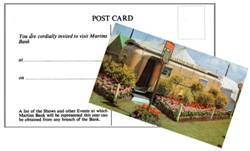
a third of a page to a whole page and sometimes more. Other forms of advertising include counter plaques, the mobile branch
showcard and display material for our stands at exhibitions—advertising on home ground, as it were.
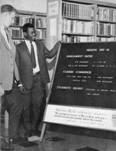
External advertising includes the individual advertisements appearing on
notice boards which are installed at many universities, technical colleges
and similar establishments throughout the country. For
newspaper advertising artists who are skilled in drawing and have a wide
knowledge of typefaces, layout design and photography, join with copy writers
to prepare the actual advertisements. Then follows the technical task of
producing the blocks for distribution to the newspapers and periodicals. The administrative link between agency and
advertiser is, in our case, Advertising Department at Head Office which is
additionally responsible for press relations.
This work includes preparing the special features which appear in one
or more newspapers every time a new branch opens or premises are modernised.
The size of the space allocated by the newspaper for the features varies from
a third of a page to a whole page and sometimes more. Other forms of advertising include counter plaques, the mobile branch
showcard and display material for our stands at exhibitions—advertising on home ground, as it were.
External advertising includes the individual advertisements appearing on
notice boards which are installed at many universities, technical colleges
and similar establishments throughout the country.
 Last
but by no means least of our methods of advertising the Bank and its services
are the forty-five or so booklets and leaflets produced by or through
Advertising Department. Keeping the contents accurate and up-to-date can be
as time-consuming as preparing a new publication. Many a story could be told
of the difficulties encountered in trying to achieve a particular
photographic effect for a publication. Is it worth it ? Is the time and money well spent ? How can
one know if advertising is increasing business? These questions and many more
have been asked by advertisers and the public at large since advertising
began and will continue to be asked while it exists. The advertiser with a
product to sell can find comfort if his sales rise but a bank selling only
service has no such yardstick; a man will not put on his hat and rush down
the street to open an account at our Bank merely because an advertisement
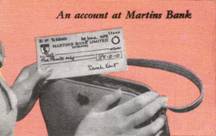
suggests that he should do so. However, many requests for the Bank's
publications are received every day in response to our advertisements, and
any magazine advertisement incorporating a cut-out coupon requesting a copy
of An Account at Martins Bank brings
constant letters. If these examples can be taken as a guide then they may
well account for the fact that all banks are tending to increase their
expenditure on advertising. What of
those forms of advertisement over which Advertising Department has no control—the Bank's premises, its staff, its signs, letter-heads
and cheques? They all play their part, particularly the staff who are largely
responsible for the follow-up to any advertisements. Seeing that a
newly-advertised booklet is displayed in a tidy counter dispenser at the
earliest opportunity is just one of the ways in which the staff helps to
corroborate the claim of the Bank's advertisements that Martins Bank
provides a service second to none. Last
but by no means least of our methods of advertising the Bank and its services
are the forty-five or so booklets and leaflets produced by or through
Advertising Department. Keeping the contents accurate and up-to-date can be
as time-consuming as preparing a new publication. Many a story could be told
of the difficulties encountered in trying to achieve a particular
photographic effect for a publication. Is it worth it ? Is the time and money well spent ? How can
one know if advertising is increasing business? These questions and many more
have been asked by advertisers and the public at large since advertising
began and will continue to be asked while it exists. The advertiser with a
product to sell can find comfort if his sales rise but a bank selling only
service has no such yardstick; a man will not put on his hat and rush down
the street to open an account at our Bank merely because an advertisement
suggests that he should do so. However, many requests for the Bank's
publications are received every day in response to our advertisements, and
any magazine advertisement incorporating a cut-out coupon requesting a copy
of An Account at Martins Bank brings
constant letters. If these examples can be taken as a guide then they may
well account for the fact that all banks are tending to increase their
expenditure on advertising. What of
those forms of advertisement over which Advertising Department has no control—the Bank's premises, its staff, its signs, letter-heads
and cheques? They all play their part, particularly the staff who are largely
responsible for the follow-up to any advertisements. Seeing that a
newly-advertised booklet is displayed in a tidy counter dispenser at the
earliest opportunity is just one of the ways in which the staff helps to
corroborate the claim of the Bank's advertisements that Martins Bank
provides a service second to none.
 M M
|