|
  Although Martins is the first bank – in 1959 - to use
a computer to handle the day to day processing of customers’ accounts, the
rollout of the necessary equipment and the conversion of accounts by the
allocation of account numbers is very slow.
Experiments take place at several branches up and down the land to
measure the impact of computer accounting on the workload of branches, but
sadly Martins never quite reaches the stage of full conversion to computer
operation before the merger with Barclays.
Computer centres are established at Liverpool Head Office and in
London, with Liverpool Heywoods, and London South Audley Street Branches
processing their day’s work directly onto computer using punched paper tape.
In 1966 Martins opens what for that time is the state of the art LONDON
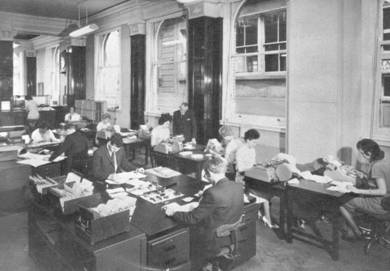
COMPUTER CENTRE at Bucklersbury House in Wallbrook, London. The above image shows the
machine accounting room at Liverpool Heywoods Branch in 1963. The process of
computerisation requires a number of time consuming clerical stages to
complete - Account numbers must be allocated to every account of every
customer. The numbers must be recorded on every voucher that passes through
every account. The account number and transaction details have to be punched
onto paper tape which is then read by the computer. Transactions are added on
to or taken away from the running balance of the customer’s account. The
computer also records statistical information that will help staff with the
calculation of bank charges and interest. Although Martins is the first bank – in 1959 - to use
a computer to handle the day to day processing of customers’ accounts, the
rollout of the necessary equipment and the conversion of accounts by the
allocation of account numbers is very slow.
Experiments take place at several branches up and down the land to
measure the impact of computer accounting on the workload of branches, but
sadly Martins never quite reaches the stage of full conversion to computer
operation before the merger with Barclays.
Computer centres are established at Liverpool Head Office and in
London, with Liverpool Heywoods, and London South Audley Street Branches
processing their day’s work directly onto computer using punched paper tape.
In 1966 Martins opens what for that time is the state of the art LONDON
COMPUTER CENTRE at Bucklersbury House in Wallbrook, London. The above image shows the
machine accounting room at Liverpool Heywoods Branch in 1963. The process of
computerisation requires a number of time consuming clerical stages to
complete - Account numbers must be allocated to every account of every
customer. The numbers must be recorded on every voucher that passes through
every account. The account number and transaction details have to be punched
onto paper tape which is then read by the computer. Transactions are added on
to or taken away from the running balance of the customer’s account. The
computer also records statistical information that will help staff with the
calculation of bank charges and interest.

|
|
|
|
Image © Martins Bank
Archive Collections
|
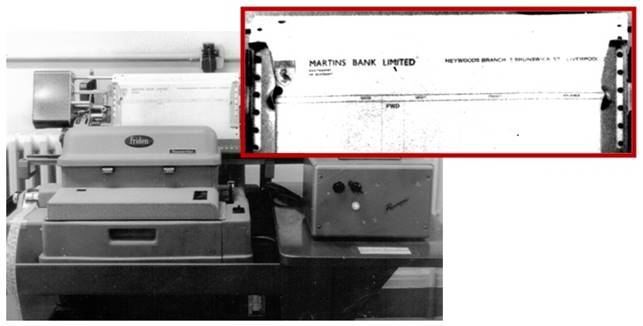
The Friden “Flexowriter” at
Liverpool Computer centre, with (inset) a statement ready to print for
Heywoods Branch.
Images © Martins Bank Archive Collections - Ron Hindle
Estate
|

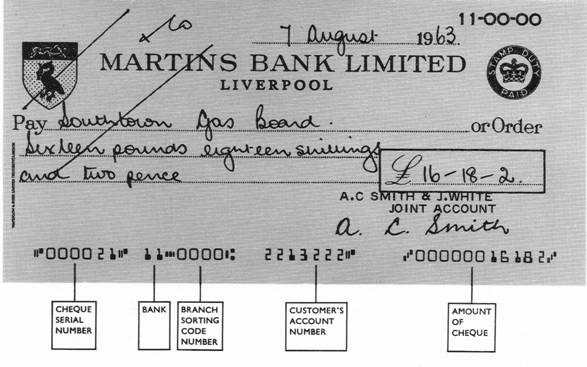
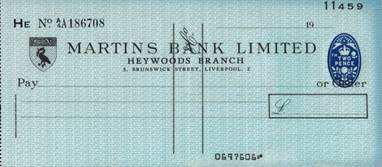 This is a very early example of a Heywoods cheque
encoded with an account number. Later,
the branch sorting code number, and a cheque number will also be encoded
along the bottom edge of the cheque, as in the example below. In 1968 customers of 68 Lombard St Branch
receive letters explaining that they are next for automation… Best of all, the age of “error free” banking has finally arrived -
Thanks to READER/SORTER technology, machines can now read the information printed on cheques,
and sort each cheque according by any part of that information. This ensures (in theory) that YOUR account
and nobody else’s will be debited. But
how does it work? The process of
developing special characters that can be read by machines and humans alike
was long and labourious, but finally Banks in Britain and America have settled upon a common ‘code’ that is used
to represent customers’ information in the form of the magnetic E13B
typeface. For an in-depth look at how these numbers work, click HERE This is a very early example of a Heywoods cheque
encoded with an account number. Later,
the branch sorting code number, and a cheque number will also be encoded
along the bottom edge of the cheque, as in the example below. In 1968 customers of 68 Lombard St Branch
receive letters explaining that they are next for automation… Best of all, the age of “error free” banking has finally arrived -
Thanks to READER/SORTER technology, machines can now read the information printed on cheques,
and sort each cheque according by any part of that information. This ensures (in theory) that YOUR account
and nobody else’s will be debited. But
how does it work? The process of
developing special characters that can be read by machines and humans alike
was long and labourious, but finally Banks in Britain and America have settled upon a common ‘code’ that is used
to represent customers’ information in the form of the magnetic E13B
typeface. For an in-depth look at how these numbers work, click HERE

 M M
|



