|
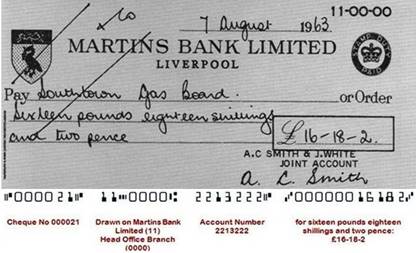
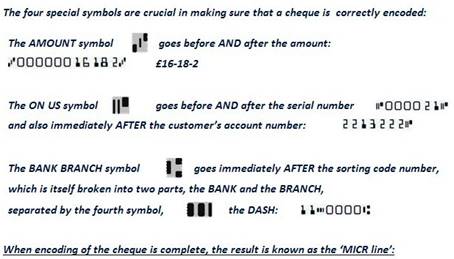
 In 1963 some Martins’ machine room staff in Liverpool and London make
the change from listing items on mechanical adding machines and statement
printers, to using the latest encoding machines to print, in magnetic ink,
a monetary value along the bottom of each cheque. Together with other information already
printed on the cheque, such as a serial number, the sorting code number
that identifies a particular branch of Martins, and most importantly an
account number, the cheque is thus equipped to be read and sorted by
machine, enabling funds to be quickly removed from a customer’s
balance. The allocation of account
numbers is met with some resistance by customers who feel that banking will
become impersonal – up to this point not even the customer’s name has been
printed on a cheque, and staff have to rely solely on recognising and
comparing a customer’s signature with branch records! A sophisticated system of account numbers
involving a complex mathematical check of the account number against the
sorting code, has been developed for all banks, and this effectively
prevents the customer from being debited for a transaction that isn’t
theirs. In 1963 some Martins’ machine room staff in Liverpool and London make
the change from listing items on mechanical adding machines and statement
printers, to using the latest encoding machines to print, in magnetic ink,
a monetary value along the bottom of each cheque. Together with other information already
printed on the cheque, such as a serial number, the sorting code number
that identifies a particular branch of Martins, and most importantly an
account number, the cheque is thus equipped to be read and sorted by
machine, enabling funds to be quickly removed from a customer’s
balance. The allocation of account
numbers is met with some resistance by customers who feel that banking will
become impersonal – up to this point not even the customer’s name has been
printed on a cheque, and staff have to rely solely on recognising and
comparing a customer’s signature with branch records! A sophisticated system of account numbers
involving a complex mathematical check of the account number against the
sorting code, has been developed for all banks, and this effectively
prevents the customer from being debited for a transaction that isn’t
theirs.

|
|
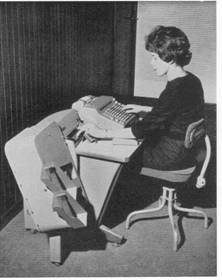
A cheque is placed in the encoding
compartment of a
National Cash Register Company
(NCR) encoding machine.
|
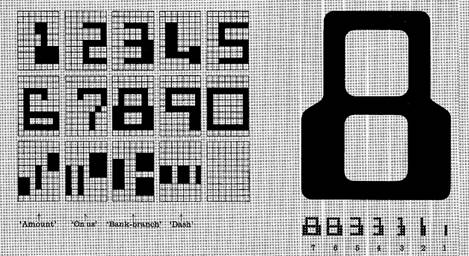
The principles of electronic
reading, showing how characters printed in magnetic ink are sensed and interpreted.
70 “blocks” are scanned by powerful logic circuits to interpret each of the
14 permitted characters in the E13B typeface.
|
|
Reading and Sorting
 The
multi-channel reading head of the IBM
READER/SORTER
machine breaks up the characters into 10 horizontal elements. Seven
separate readings are made as the character passes under the reading head,
so that each numeral or special character is divided into 70 blocks, or
sensing areas. The presence or absence of magnetic ink in each of these
sensing areas is recorded in an electronic register, which therefore builds
up an image of the printed character. Powerful logic circuits compare this
image with the perfect character, and with the thousands of permitted variations. Some variation is inevitable, and the
machine’s usefulness would be very limited if only perfect reproductions
were accepted. It therefore rejects
only those images in the electronic register which could be related to more
than one of the 14 possible characters. The characters which make up the
E13B typeface have been carefully designed after exhaustive analyses of
comparative shapes. Each is as
different as possible from all the others, yet retains its legibility for
the human reader. The
multi-channel reading head of the IBM
READER/SORTER
machine breaks up the characters into 10 horizontal elements. Seven
separate readings are made as the character passes under the reading head,
so that each numeral or special character is divided into 70 blocks, or
sensing areas. The presence or absence of magnetic ink in each of these
sensing areas is recorded in an electronic register, which therefore builds
up an image of the printed character. Powerful logic circuits compare this
image with the perfect character, and with the thousands of permitted variations. Some variation is inevitable, and the
machine’s usefulness would be very limited if only perfect reproductions
were accepted. It therefore rejects
only those images in the electronic register which could be related to more
than one of the 14 possible characters. The characters which make up the
E13B typeface have been carefully designed after exhaustive analyses of
comparative shapes. Each is as
different as possible from all the others, yet retains its legibility for
the human reader.

|