|
|
|
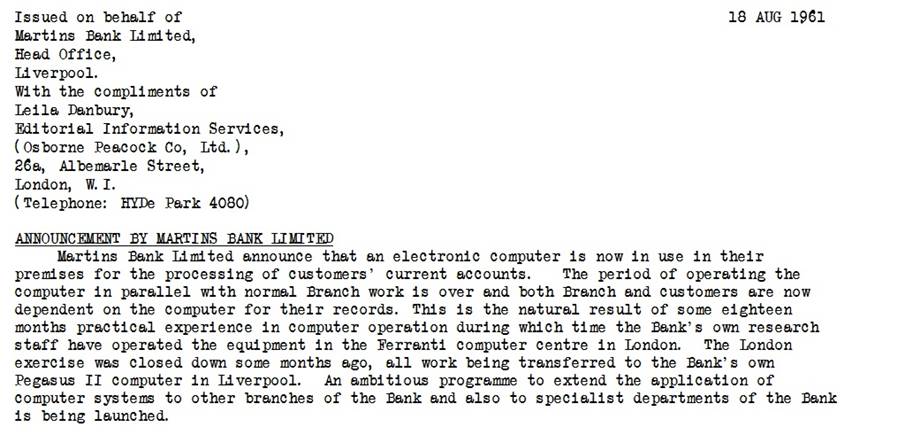
Issued on behalf of 18
AUG 1961 Martins Bank
Limited, Head Office, Liverpool. With the compliments of Leila Danbury, Editorial
Information Services, (Osborne-Peacock Co, Ltd.), 26a, Albemarle
Street, London, W.I. (Telephone: HYDe Park 4080) ANNOUNCEMENT BY MARTINS BANK LIMITED Martins Bank Limited
announce that an electronic computer is now in use in their premises for the
processing of customers' current accounts.
The period of operating the computer in parallel with normal Branch
work is over and both Branch and customers are now dependent on the computer
for their records. This is the natural result of some eighteen months
practical experience in computer operation during which time the Bank's own
research staff have operated the equipment in the Ferranti computer centre in
London. The London exercise was closed
down some months ago, all work being transferred to the Bank's own Pegasus II
computer in Liverpool. An ambitious
programme to extend the application of computer systems to other branches of the
Bank and also to specialist departments of the Bank is being launched. Successful
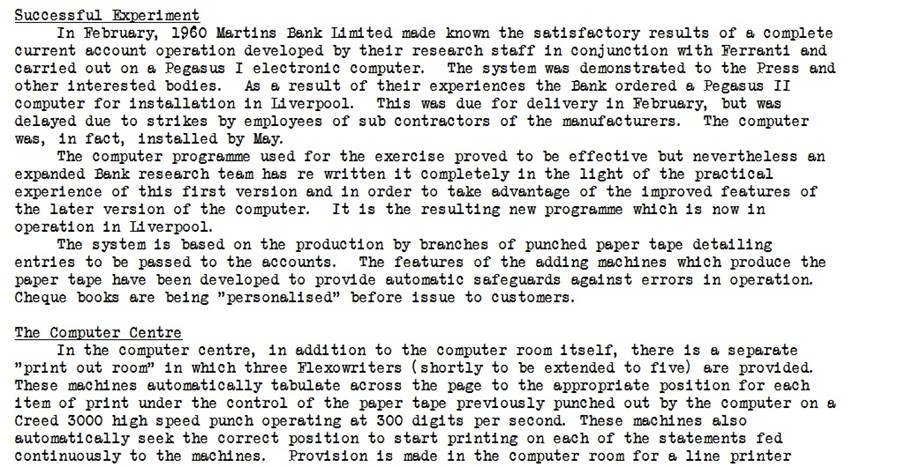
Experiment In February, 1960
Martins Bank Limited made known the satisfactory results of a complete
current account operation developed by their research staff in conjunction
with Ferranti and carried out on a Pegasus I electronic computer. The system was demonstrated to the Press
and other interested bodies. As a
result of their experiences the Bank ordered a Pegasus II computer for
installation in Liverpool. This was
due for delivery in February, but was delayed due to strikes by employees of
sub-contractors of the manufacturers.
The computer was, in fact, installed by May. The
computer programme used for the exercise proved to be effective but
nevertheless an expanded Bank research team has re-written it completely in
the light of the practical experience of this first version and in order to
take advantage of the improved features of the later version of the
computer. It is the resulting new
programme which is now in operation in Liverpool. The system is based on
the production by branches of punched paper tape detailing entries to be
passed to the accounts. The features
of the adding machines which produce the paper tape have been developed to
provide automatic safeguards against errors in operation. Cheque books are being
"personalised" before issue to customers. The Computer Centre In the computer
centre, in addition to the computer room itself, there is a separate
"print-out room" in which three Flexowriters (shortly to be
extended to five) are provided. These machines automatically tabulate across
the page to the appropriate position for each item of print under the control
of the paper tape previously punched out by the computer on a Creed 3000 high
speed punch operating at 300 digits per second. These machines also
automatically seek the correct position to start printing on each of the
statements fed continuously to the machines.
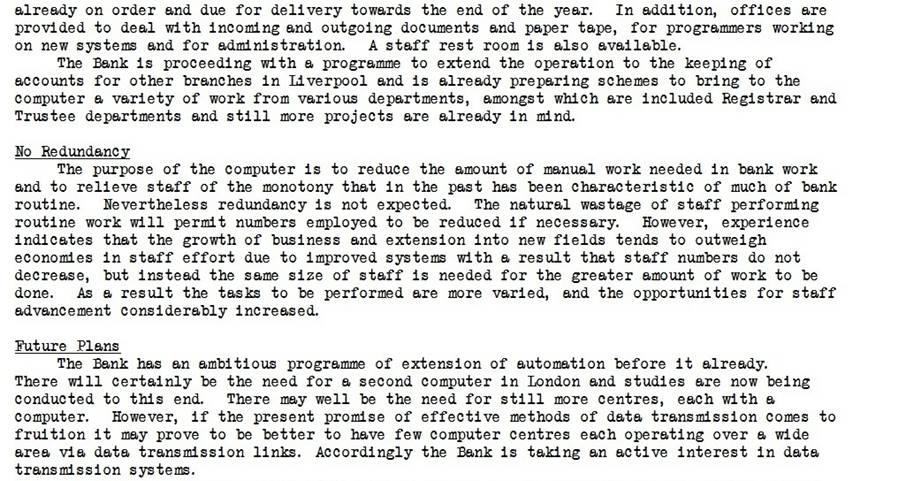
Provision is made in the computer room for a line printer already on
order and due for delivery towards the end of the year. In addition, offices are provided to deal
with incoming and outgoing documents and paper tape, for
programmers working on new systems and for administration. A staff rest room is also available. The Bank is proceeding
with a programme to extend the operation to the keeping of accounts for other
branches in Liverpool and is already preparing schemes to bring to the computer
a variety of work from various departments, amongst which are included
Registrar and Trustee departments and still more projects are already in
mind. No Redundancy The
purpose of the computer is to reduce the amount of manual work needed in bank
work and to relieve staff of the monotony that in the past has been
characteristic of much of bank routine.
Nevertheless redundancy is not expected. The natural wastage of staff performing
routine work will permit numbers employed to be reduced if necessary. However, experience indicates that the
growth of business and extension into new fields tends to outweigh economies
in staff effort due to improved systems with a result that staff numbers do
not decrease, but instead the same size of staff is needed for the greater
amount of work to be done. As a result
the tasks to be performed are more varied, and the opportunities for staff
advancement considerably increased. Future Plans The
Bank has an ambitious programme of extension of automation before it already. There will certainly be the need for a
second computer in London and studies are now being conducted to this
end. There may well be the need for
still more centres, each with a computer.
However, if the present promise of effective methods of data
transmission comes to fruition it may prove to be better to have few computer
centres each operating over a wide area via data transmission links.
Accordingly the Bank is taking an active interest in data transmission
systems. The
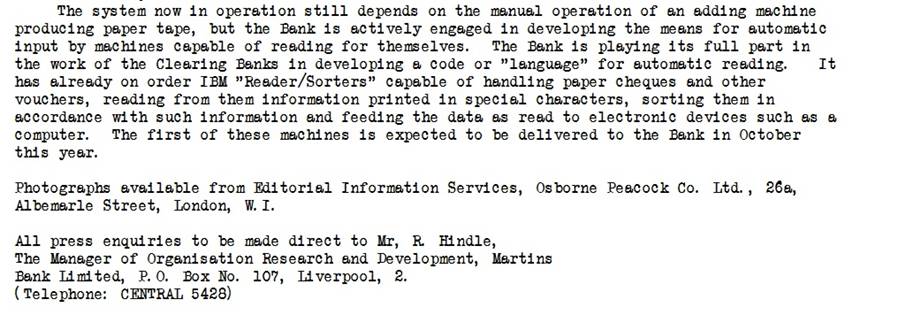
system now in operation still depends on the manual operation of an adding
machine producing paper tape, but the Bank is actively engaged in developing
the means for automatic input by machines capable of reading for
themselves. The Bank is playing its
full part in the work of the Clearing Banks in developing a code or
"language" for automatic reading.
It has already on order IBM "Reader/Sorters" capable of
handling paper cheques and other vouchers, reading from them information
printed in special characters, sorting them in accordance with such
information and feeding the data as read to electronic devices such as a
computer. The first of these machines
is expected to be delivered to the Bank in October this year. Photographs
available from Editorial Information Services, Osborne-Peacock Co. Ltd., 26a,
Albemarle Street, London, W.I. All
press enquiries to be made direct to Mr, R. Hindle, The
Manager of Organisation Research and Development, Martins Bank
Limited, P.O. Box No. 107, Liverpool, 2. (Telephone:
CENTRAL 5428) |
|
|
|
|
|
© gut informiert 2007 to date |