|


 Slowly but surely, Martins Bank moves down the East
Coast towards East Anglia, the final destination of the southern expansion
which started back in the early 1930s, but more importantly, and perhaps
frighteningly, the heartland of the Bank’s main rival – Barclays. East Yorkshire, Lincolnshire,
Northamptonshire and Cambridgeshire each receives a scattering of branches,
and in Norfolk, King’s Lynn is added, with three further branches open in
Norwich. Time is however running out, and hopes of Martins Bank being able
to complete a larger National network of branches are dashed by the merger
with Barclays. Many of the Eastern
and South Eastern branches that are added in the 1950s and 60s are not
needed by Barclays, and are closed at the time of the merger or just after.
Spalding fares better, remaining open until 2024, although it was
originally closed for some eighteen months in the early 1970s. In this
wonderful colour image from Martins Bank Archive Collections, we see from
May 1967 the triumphant ride through the town of the very first DEPUTY Miss
Tulipland – Mrs Vivienne Bowman – on a float that is completely carpeted
with fresh tulips, all part of a tradition which began in 1950. Shortly
after the Spalding first opened for business, Martins Bank Magazine went to
meet the staff and take a look at the teak panelling and latest ceiling
lighting techniques – the kind of fixtures and fittings over which the
writers of the Magazine writers were to regularly salivate, as Martins
poured more and more money into its Branch network… Slowly but surely, Martins Bank moves down the East
Coast towards East Anglia, the final destination of the southern expansion
which started back in the early 1930s, but more importantly, and perhaps
frighteningly, the heartland of the Bank’s main rival – Barclays. East Yorkshire, Lincolnshire,
Northamptonshire and Cambridgeshire each receives a scattering of branches,
and in Norfolk, King’s Lynn is added, with three further branches open in
Norwich. Time is however running out, and hopes of Martins Bank being able
to complete a larger National network of branches are dashed by the merger
with Barclays. Many of the Eastern
and South Eastern branches that are added in the 1950s and 60s are not
needed by Barclays, and are closed at the time of the merger or just after.
Spalding fares better, remaining open until 2024, although it was
originally closed for some eighteen months in the early 1970s. In this
wonderful colour image from Martins Bank Archive Collections, we see from
May 1967 the triumphant ride through the town of the very first DEPUTY Miss
Tulipland – Mrs Vivienne Bowman – on a float that is completely carpeted
with fresh tulips, all part of a tradition which began in 1950. Shortly
after the Spalding first opened for business, Martins Bank Magazine went to
meet the staff and take a look at the teak panelling and latest ceiling
lighting techniques – the kind of fixtures and fittings over which the
writers of the Magazine writers were to regularly salivate, as Martins
poured more and more money into its Branch network…

The right time to visit Spalding is really towards the end of
April or the beginning of May when the fields are a blaze of colour. That
is the time when the flower processions are held and cars converge from
miles around to see this spectacle of colour which rivals the fields of
Holland itself. We were not
able so to time our visit, and had to be content with seeing acres of
golden daffodils under a rain-washed sky. We made our visit to the new
branch on the last day of March and it rained pitilessly from the time of
our arrival until after our departure. It takes more than a drop of water
to deter us, however, as they know well in these parts. Last time we were
here, to visit our new branch at Lincoln, Mr. Wilmot drove us through what
seemed to be a river in flood, and we survived that, so Spalding held no
terrors for us.
|
In Service: 1959 to 21 July 1972 then reopened 1974 until
10 May 2024
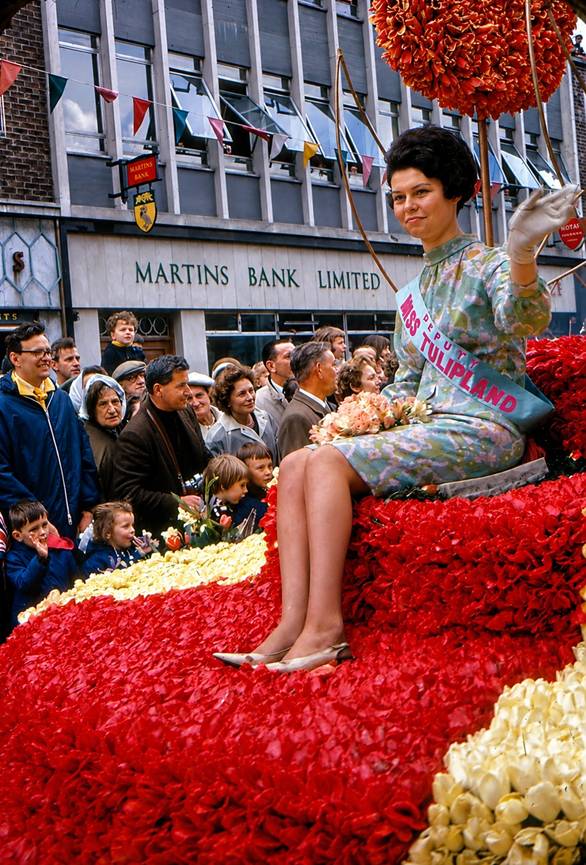
Image © Martins Bank Archive Collections
|
|
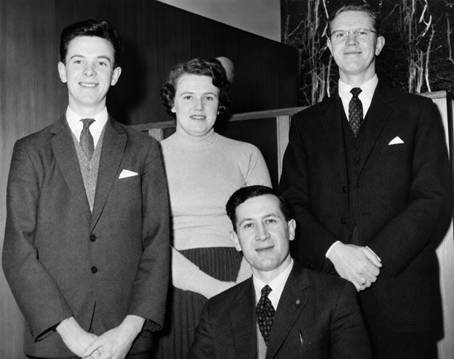 As
a matter of fact, the visit was the occasion for a very happy reunion. Mr.
C. M. Tenneson, Manager of the new branch, was second in command at Lincoln
at the time of our visit, and we first met Mrs. Tenneson on that occasion.
It was a great pleasure to spend a happy evening with them both. Mr.
Tenneson commenced his career in the Liverpool District and after serving
there for eleven years went to the Manchester District, where he served at
various branches before his translation to the Midland District. As
a matter of fact, the visit was the occasion for a very happy reunion. Mr.
C. M. Tenneson, Manager of the new branch, was second in command at Lincoln
at the time of our visit, and we first met Mrs. Tenneson on that occasion.
It was a great pleasure to spend a happy evening with them both. Mr.
Tenneson commenced his career in the Liverpool District and after serving
there for eleven years went to the Manchester District, where he served at
various branches before his translation to the Midland District.
Mr. D. B. Woolgar, second to Mr. Tenneson, is also known to
us. He has spent all his time up to now in the London District, at Sidcup,
Chislehurst and elsewhere, but has accepted this opportunity with alacrity
and enthusiasm as a means of widening his experience and of enabling him to
fit himself for further responsibility. His wife and family have settled
down quite happily in this very different part of the world. Mr. David Simpson, who travels about sixteen miles from
Boston each day, is doing what he wants to do. He was determined to get
into a bank and not being able to find an opening in Boston itself he
joined Martins Bank as soon as the branch was opened.
 He
is very keen and conscientious and it is nice to meet someone so happy in
his job. Miss Joy Chenery, who
represents the female staff, was secretary to a farmer for several years,
but with a brother in a bank and with the desire to meet the public she
decided to exchange farm book-keeping for bank book-keeping. She had the
opportunity of spending a week at Head Office in connection with work on
the Rights Issue, but prefers to work permanently on her native heath. On seeing Spalding under the worst possible conditions,
in pouring rain at the close of market day after everyone had gone away,
our first thought was one of mild speculation as to why we had decided to
open there before Boston and Peterborough, but the place is, after all, the
capital and centre of bulb land. It is a rich town and we do need to extend
our representation further in this part of the world. He
is very keen and conscientious and it is nice to meet someone so happy in
his job. Miss Joy Chenery, who
represents the female staff, was secretary to a farmer for several years,
but with a brother in a bank and with the desire to meet the public she
decided to exchange farm book-keeping for bank book-keeping. She had the
opportunity of spending a week at Head Office in connection with work on
the Rights Issue, but prefers to work permanently on her native heath. On seeing Spalding under the worst possible conditions,
in pouring rain at the close of market day after everyone had gone away,
our first thought was one of mild speculation as to why we had decided to
open there before Boston and Peterborough, but the place is, after all, the
capital and centre of bulb land. It is a rich town and we do need to extend
our representation further in this part of the world.
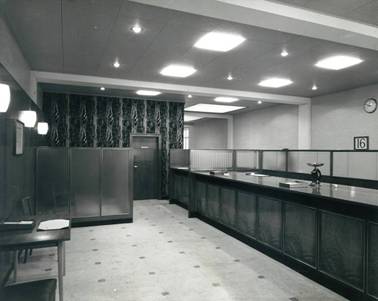 The
branch itself is one of the most attractive of our new branches. Panelled
in teak with the latest ceiling lighting to set it off, the interior has a
sunshiny, welcoming effect. The office and the counter space are of ample
proportions and the whole effect is one of dignified modernity, exactly the
right contrast being provided by the very modern wallpaper which faces the
door and catches the eye of the customer on entering the Bank. The office
is all on one level and the Manager's room, waiting room and staff rooms
are most attractively decorated and furnished. The
branch itself is one of the most attractive of our new branches. Panelled
in teak with the latest ceiling lighting to set it off, the interior has a
sunshiny, welcoming effect. The office and the counter space are of ample
proportions and the whole effect is one of dignified modernity, exactly the
right contrast being provided by the very modern wallpaper which faces the
door and catches the eye of the customer on entering the Bank. The office
is all on one level and the Manager's room, waiting room and staff rooms
are most attractively decorated and furnished.
Premises Department have
done one of their best jobs here, and the complete lack of ostentation, so
often associated with buildings of modern design, is not the least
attractive feature of the place. We toured the area around the town to get
some idea of the layout and were much impressed by the well cared for
appearance of the farm buildings everywhere. The straight rivers, not
unlike canals, the marshlands, the lines of poplars planted as wind breaks,
the ubiquity of the weeping willow tree and the fields of tulips already
showing promise of the glory to come, provided a unique and unforgettable
picture of this very distinctive corner of England with that fertile
two-crop silt, which is the foundation of its prosperity as one of the most
valuable of the market gardens of England. Just before we left we were glad to be able to pay a
quick visit to the home of Mr. and Mrs. Tenneson. It is charmingly situated
with a lovely view of trees and gardens at the rear. Mrs. Tenneson is as proud of the Bank and of her
husband's branch as he is himself and its progress is, in every sense of
the word, a family matter.
|