|
|


<

|
AN ACCOUNT AT MARTINS BANK |
|
|
|
||||||||||||||||||
|
It is not necessary to be rich to have a
banking account, but more and more people are beginning to appreciate the
convenience and wisdom of keeping their money in a bank. There are three principal ways in which a banking account
can be of great help: by ensuring the absolute safety of your money; by
offering a method of keeping your financial affairs in order; and by
providing a means of saving. There are three main types of account which you
can open at
Martins Bank—current
accounts, deposit accounts and savings accounts. Current accounts The current account is the usual type of
account into which you can pay the money you receive and out of which you can
draw cash as you require it or pay your various outgoings. For instance, you
can pay in your salary or wages or arrange for them to be put into your
account direct, and you can pay in any other cash or cheques or dividends
which you may receive; and all your outgoings such as coal, gas, electricity,
rent, rates, taxes, insurance premiums, hire-purchase instalments and so on
can be paid either by cheque or by credit transfer. If you are a housewife,
you can pay in your housekeeping allowance and settle your accounts at the
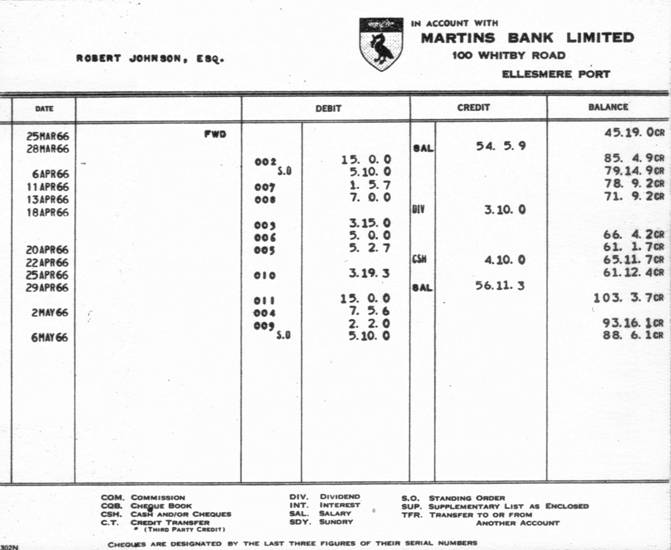
various shops by cheque. The Bank keeps a record of your account for you,
which is called a statement. In one column are listed all the amounts paid
in, and in another all the amounts paid out, the remaining balance being
clearly shown. This enables you to have a useful picture of your financial
affairs —and
that is a big step towards saving.
Deposit accounts, on which interest is payable,
are for money placed “on deposit” for a minimum of seven days, and for which
seven days' notice of withdrawal is normally required. Savings accounts Savings accounts, on which interest is
also allowed, can be opened at Martins Bank by anyone. Deposits of 1/-d. or
more will be accepted, and a special box can be provided for collecting notes
and coins at home. A cheque book is not issued for a savings account but
withdrawals of up to £20
can be made at any branch of Martins Bank or Lewis's Bank on production of
your passbook containing a specimen of your signature.
The cost of a banking account Each half year the Bank makes a charge for
operating a current account, according to the work that is involved. The
amount is often surprisingly small and indeed may be nothing at all if a
reasonable balance is kept. No charges are made on deposit or savings
accounts. If you wish, your account can be opened in joint names—your
own together with that of either your wife or some other person(s).
If you call at any of the Bank's branches or
write to the manager, we will be
pleased to give you full details and help
you to decide which type of account will suit your needs.
Your cheques cashed The
Bank will arrange for you to cash your cheques
anywhere in the country where there is a bank,
either at one of its own branches or at a branch of
another bank. Financial assistance The
Bank will be prepared to discuss with you the granting of an overdraft or other
financial assistance if ever this is required. Investment service If
you want help or advice about investments, our Managers will gladly obtain
for you advice from the experts in such matters. H.P. instalments,
insurance premiums and other regular
payments. You
can arrange for the Bank to make these payments automatically from your
account when they become due. Your Income Tax
If you wish, the Bank will attend to your Income
Tax affairs for you. Your
Will The
Bank can act as Executor or Trustee for you. Foreign currency and travellers' cheques. If
you go abroad the Bank can supply foreign currency, and travellers' cheques
which can be exchanged for foreign currency. Martins Bank travellers'
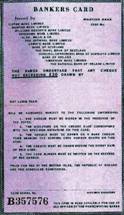
cheques can be used in this country as well. Bankers Cards Bankers
Cards are available to approved customers so that their cheques are more
readily acceptable in payment for goods and services, or can be cashed
without prior arrangement at a large number of
branches of banks all over Britain and Ireland.
A
reference supplied The Bank can supply a
reference for you, a useful facility if you
are applying for a passport or opening a
shopping or credit account. Your valuables guarded The
Bank provides accommodation in its strong rooms and safes for your deeds, share certificates,
or other documents of value, and for locked boxes
or sealed parcels containing jewellery or other
valuables. In all these matters strict secrecy is observed
and your affairs
will not be divulged to any other person—not
even to a relation—without your knowledge and
permission. In addition., any customer can
draw upon the experience and knowledge of the bank manager and enjoy his friendly help and guidance
without obligation.
At this point we should perhaps tell you something about
ourselves. Martins Bank operates over 700 branches throughout England,
Wales., the Channel Islands and the Isle of Man. The Bank started as the Bank of
Liverpool over 130 years ago but the old private bank., Martin's Bank.,
London., which became part of the larger bank in 1918, dates back to 1563.
The grasshopper in the Bank's coat of arms is the emblem which Sir Thomas Gresham,
the famous Elizabethan financier, displayed outside his house in Lombard
Street, where our principal London office now stands, and where banking
business has been done without a break since the sixteenth century. The bird which is prominently displayed
on our coat of arms is the Liver Bird of Liverpool. The constant aim of our
managers and every member of our staff is the maintenance of a friendly
personal relationship with every customer, whose presence in the bank is
always welcomed whether he has £i or £1,000 in his account. Again and again our
customers tell us "Martins Bank is such a friendly bank" and we
train our staff in this tradition to provide a very important public service. It is also of interest to note that in
the course of our growth we have absorbed or amalgamated with over thirty
smaller banks, many of them family concerns who have the same excellent
tradition. We hope, after what we have said, that you will feel that we have
something to offer you and you will now want to know how to set about opening
your account and how to conduct it.
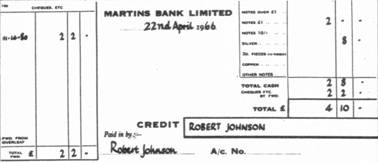
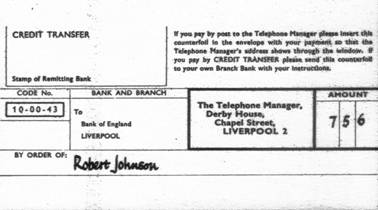
Paying money in
Other accounts
The procedure for opening a deposit
account or a savings account is equally simple: anyone behind the counter
will explain it to you. No reference is needed to open a savings account. The use of a cheque book The Bank itself makes
no charge for a cheque book, but it collects the stamp duty of 2d. on each cheque
and hands it over to the revenue authorities. Cheques for current accounts
are supplied in books of various sizes to suit requirements. The use of a
cheque book avoids the necessity of carrying large sums of cash about with
you and can provide also a convenient record of the payments you make from
your balance in the Bank. You can give cheques to almost anyone to whom you
owe money. You also use cheques to draw cash for yourself from your account
and, as we mentioned earlier, one of the great advantages of having a banking
account is that we can arrange for you to get cash in this way at any branch
of any bank in the British Isles. This is an added convenience if you are
staying in a place where there is no branch of Martins Bank.
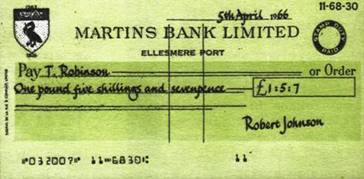
To write a cheque, you fill in the name
of the person or firm to whom payment is to be made; then, of course, you
must write in the amount of money, which must be in both words and figures as
a safeguard against accidentally filling in the wrong amount; you should
write the date in the space provided and finally put your signature at the
bottom. When writing your cheques there are a few simple rules to be observed
for both your protection and ours: 1
Always
write your cheques in ink. 2
Start
writing as far over to the left-hand side as possible and do not leave spaces
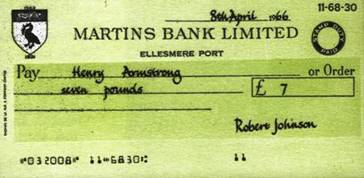
between words. The same applies to figures. If too much space is left, the
word 'seven', for example, could be altered to 'seventy' and '£7'
to '£70'. 3 If you make a mistake, alter
it in a legible way, preferably by crossing it out and re-writing the altered
word or figure; sign your name against
each alteration. 4 Always sign your cheques in the same manner
as you did when you gave the specimen of your signature on opening your
account, otherwise its authenticity may be queried. 5 Remember to fill in the counterfoil or
record sheet. Not only does this
enable you to keep up-to-date with your financial position, but you can
compare the particulars with your bank statement and, should a cheque be lost
or if for any reason you wish to stop payment of it, you will be able to give
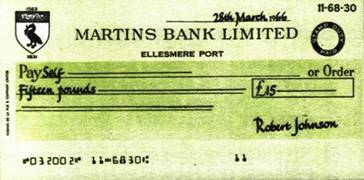
the Bank the exact details. 6 Except where you want to draw cash for your
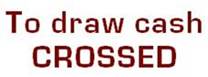
self, it is a valuable safeguard to 'cross' your cheques in the manner
indicated in the illustration which shows the correct way to write a cheque.
This prevents anyone from getting cash at a bank counter if, for example, you
dropped a cheque in the street and someone picked it up and tried to cash
it, because a cheque which is crossed has to be paid into a banking account
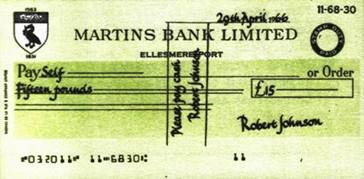
and cannot be cashed across the counter. Your cheque book can be supplied
with cheques already crossed, or you can draw the two parallel lines on each
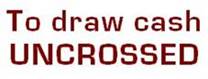
cheque yourself when required. The disadvantage of a book of crossed cheques
is that when you want to draw money yourself you have to 'cancel the
crossing' by writing between the parallel lines 'Please pay cash' and adding
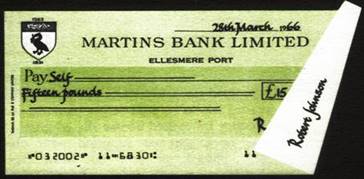
your usual signature, as shown in the illustration 7 When you use a cheque for the purpose of
drawing cash for yourself you should endorse it by signing your name on the
back, as indicated in the illustration.
1. Always
keep your cheque book in a safe place where no one can have access to it but
yourself. 2. Never
leave it lying about, as there is always thedanger that cheques might be torn
out of it by someone and improper use made of them. 3. Never
sign your name on the cover—someone might copy your signature on to a cheque. 4. Never
sign a cheque and leave the other spaces blank—someone might complete the cheque and obtain
money on your signature. 5. Never
allow anyone to have a cheque out of your book, even if that person says he
is a customer of the Bank. 6.
If your cheque book is missing or if you
mislay a cheque out of it, inform your bank manager immediately and ask him
to stop payment of it.
The Bank keeps a
statement of your current or deposit account listing all the amounts you
have paid in and paid out3 and showing the balance which remains.
You can arrange for your statement to be sent to you at regular intervals or
the Bank will be pleased to give you any information about your account at
any time you require it.
To give you more details of some of the services of
Martins Bank the following publications are available free of charge at any
branch: Executor and
Trustee Services Income Tax Money for
Travel Your
Investments - The Bank also publishes three guides: ·
Starting a Business in Britain Information
about business in this country
written primarily for the overseas
businessman ·
The World is Your Market ·
A
guide to overseas trading Finance
for Farmers and Growers Describes the grants and
loans available from various sources
Leeds 28-30 Park Row, 1 Liverpool 4 Water Street, 2 London 68 Lombard Street, E.C.3 Manchester 43 Spring Gardens, 2 Midland 98 Colmore row, Birmingham, 3 North Eastern 22 Grey Street., Newcastle upon
Tyne, 1 South Western 47 Corn Street, Bristol, 1 Over 700 branches throughout the country
|
|||||||||||||||||||