|
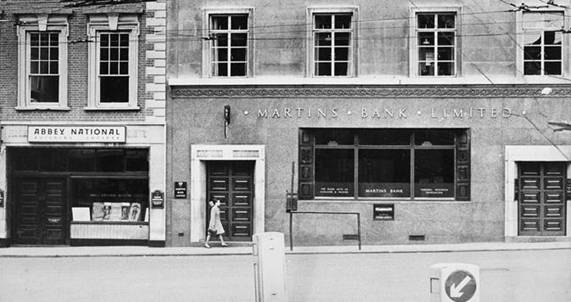
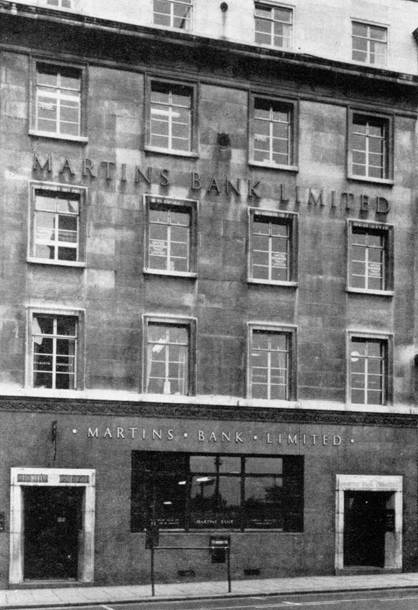
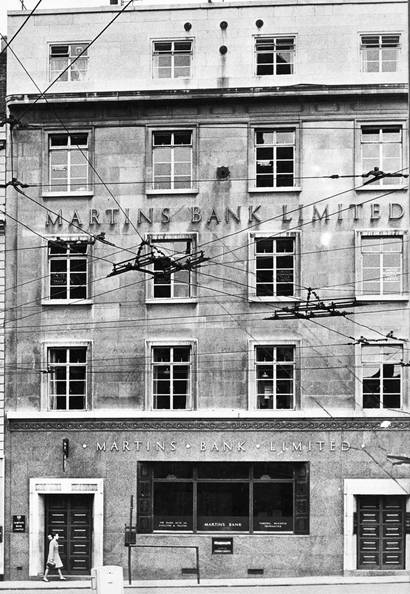
In August 1937, the Bank opens a
five storey building at No 5 Market
Place, which encompasses lavish materials, and the latest building
techniques.These include a revolutionary type of reinforced concrete that
does away with the need for supporting pillars. On 17 August 1937, the Branch opens for
Business, and the Derby Daily Telegraph runs the following article…

|
|
HANDSOME NEW
PREMISES OF
MARTINS BANK

|
|

 MARTINS
BANK, which opened temporary premises in Derby eight months ago, has
transferred its business to an imposing new building in the Market-Place,
Derby. The Bank, which was
established in 1563, has nearly 600 Branches and sub-Branches. It is represented in Birmingham,
Nottingham, Leivester, and Hanley, and there is a
sub-Branch to Birmingham Branch at Warwick. MARTINS
BANK, which opened temporary premises in Derby eight months ago, has
transferred its business to an imposing new building in the Market-Place,
Derby. The Bank, which was
established in 1563, has nearly 600 Branches and sub-Branches. It is represented in Birmingham,
Nottingham, Leivester, and Hanley, and there is a
sub-Branch to Birmingham Branch at Warwick.
The
chairman of the Bank is Mr Edward B Orme, and the deputy-chairmen are Lord
Colwyn, Sir Richard Holt, and Mr G E B Bromley-Martin. The general Manager is Mr J M
Furniss. The Derby headquarters are
five storeys high, and are constructed with a reinforced concrete frame
with reinforced concrete floors on the Diagrid principle, which will carry
over a large span without the use of beams, thus saving in height and
enabling a flat ceiling to be obtained.

EXTERIOR DESIGN
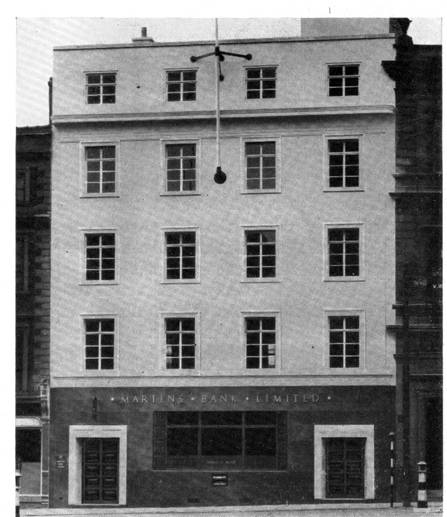
The
design of the exterior of the building is based on the Classic style, with
simple modern treatment. Up to the
first-floor level, the front is faced with sea green granite, with the two
entrance doors in polished Travertine marble. Above the first-floor level the facing is
in Portland stone. One of the main
features of the front of the building is the bronze window to the banking
hall, which has splayed reveals with motifs in low relief of banking
business. In the panel below the
window, a night safe has been installes for the
convenience of the Bank’s customers.
The ground floor and the basement are occupied by the bank, the
first, second, and third floors will be let to tenants, and the caretaker’s
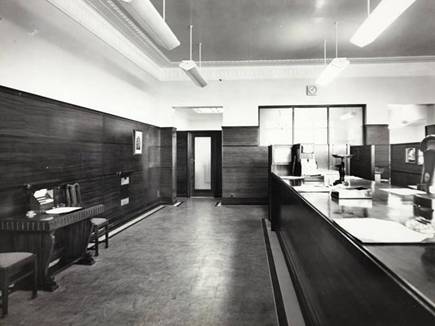
quarters are on the fourth floor. On the ground floor are a very roomy
public space, manager’s room, waiting room, counter for three cashiers, and
desk accommodation for seven clerks.
There is also an entrance hall to the offices on the upper floors,
with lift and staircase, together with a large office at the rear of the
ground floor available for the use of tenants.
PANELLED WALLS
The
walls of the banking hall up to door height are faced with Australian
walnut panelling, inlaid with hoizontal bands of
Indian laurel. Above this, the walls
and ceiling are in plaster, and the public space is covered with rubber
flooring. In the basement are housed
the stringroom, bookroom,
Staff and manager’s lavatories, and heating chamber. The whole of the basement is constructed
as a watertight tank, with waterproof and burglarproof
doors. Of particular interest is the
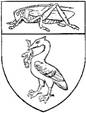
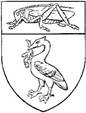
sign of the Grasshopper associated with the Bank which is to be seen
outside the new building. The
Grasshopper was the family crest of Sir Thomas Gresham, mercer, financial
advisor to Queen Elizabeth, and master of the Mint. From his house in Lombard Street he had
dealings with Richard Martins, Lord mayor of London in the year of the
Armada. In 1703 Thomas Martin became
a partner in the goldsmith and banking business carried on at the
Grasshopper. Mr R M Holland-Martin
the present chairman of the london Board of
Martins Bank, is a member of the sixth generation of Martins.

|
|
|
|
|
Branch
Images © Barclays Ref 0030-0818

CONTRACTORS ENGAGED
All the work for
the new Derby premises has been carried out by the following contractors
under the supervision of the architects, Messrs Bromley, Cartwright and Waumsley of Nottingham: General Contractors, internal
hardwood joinery, counter and desks – Messrs Gee, Walker and Slater, Ltd.,
Derby; reinforced concrete frame, Trussed Concrete Steel Co., Ltd., London;
“Diagrid” floors, Diagrid Structures Ltd., London; reinforcement in
strongroom, walls and strongroom doors, and grilles. Chatwood Safe Co.,
Ltd., Shrewsbury; granite facing, Messrs Fenning and Co., Ltd., London;
bronze and steel windows, Messrs h. Hope and Son, Ltd., Birmingham; heating
installation, Messrs Rosser and Russell Ltd., Leeds; electrical
installation, Mr W H Taylor, Derby; terrazzo pavings
and wall linings, Messrs Diespeker and Co., Ltd.,
Birmingham; natural stonework, Waller Brown, Leicester; passenger lift,
Express Lift Co., Ltd., Birmingham; rubber flooring, Runnymede Rubber Co.,
London; and carpets and linoleum, Messrs Griffin and Spalding, Nottingham.

 In the Summer 1968 issue of Martins Bank Magazine, a visit is at last
paid to Derby, more than thirty years after it first opened. The focus is
very much on the Staff and their lives, with a little local history and
details including industry and commerce thrown in for good measure. At this
point of course, no-one knows that the once mighty Branch at 5 Market
Place, has less than four years to go before the axe falls… In the Summer 1968 issue of Martins Bank Magazine, a visit is at last
paid to Derby, more than thirty years after it first opened. The focus is
very much on the Staff and their lives, with a little local history and
details including industry and commerce thrown in for good measure. At this
point of course, no-one knows that the once mighty Branch at 5 Market
Place, has less than four years to go before the axe falls…

anywhere you go in Derby, the town seems to
say it with flowers. This was the impression we gained on our brief visit
to Derby, and one confirmed by Mr Harold Lawson, Manager of our Branch in
Market Place. 'No development takes place in
Derby without a place being found for trees and plants', he explained as we
stood in the centre of Market Place, an area previously available for car
parking but now liberally sprinkled with plant containers promising a
colourful display. Across the road stood our Branch which
seemed too modern-looking to have been built in 1936. Perhaps this is
because the centre of Derby wears an aura of antiquity. It shares with most
large towns the conglomeration of old and new buildings, the narrow
streets and wide thoroughfares, yet the Borough's twelve centuries, of
which Derbians are justifiably proud, are
unmistakably present. If the historian associates Derby with the retreat of the Young
Pretender, the world has come to know the town's name as the home of Rolls
Royce. Derby's industries are many
and diversified but the fortunes of Rolls Royce are closely linked with the
fortunes of Derby and its citizens. At the time of our visit the company's
major export contracts with America were national news. 'The town is very
excited at the prospects for prosperity this can mean', Mr Lawson told us
as we stepped inside the Branch. Harold Lawson has
managed Derby Branch since 1960 but he will be remembered by former
colleagues in his native Merseyside where he worked at many Branches. He
was Clerk-in-Charge at that renowned training ground, Booker Avenue Branch,
before he moved south to open Rugby Branch in 1953. We were delighted to meet his wife who,
as Monica Ward, had been on the Staff at West Derby Branch. As a Lancashire County tennis player Mr Lawson was a valued member
of the Liverpool District tennis team. In Derby he is vice-president of
Derbyshire Lawn Tennis Association. Judged by that important Midland
District standard, tenpin bowling, the Staff of Derby Branch are not the
most dashing—they were knocked out of the District's
inter-Branch competition in the first round. Yet we found them a lively
baker's dozen.
|
|
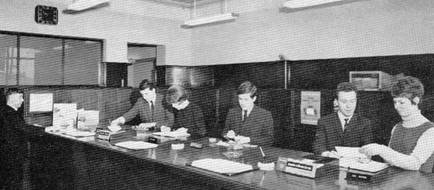
AT THE COUNTER:
Alfred Leighton (messenger), Peter Tudor, Caroline
Andrews,
David Wilesmith, Peter Ryder, Pamela Prowse
|
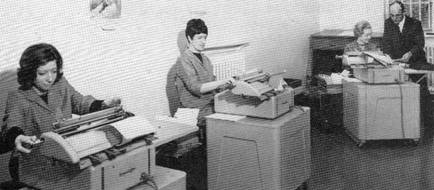
IN
THE MACHINE ROOM (1)
Brenda Marshall, Joyce Hill, Carol Bayliss,
Frank Needham (Pro Manager), Valerie Winson was on holiday when this photo
was taken
|
|
Frank Needham, Pro Manager, is more at home
with a rifle than a bowl, having been a member of King's Heath Rifle Club
since his days in Birmingham. For four years to 1962 he looked after the
premises side in Midland District Office before spending a year 'on the
desk'. From there he moved to Burton upon Trent where he still lives. He
came to Derby Branch in 1966. Most members of this young Staff have been at the Branch only a
short time. Of the five cashiers David Wilesmith, with three years at the
Branch, is an old stager—and a potential member of a
Midland District football team. Peter Tudor, a native of Birkenhead whose
father's work took him to Newcastle before bringing him to Derby, joined
the Bank in February 28 this year from the Inland Revenue. He plays cricket for a local
club.
|
|
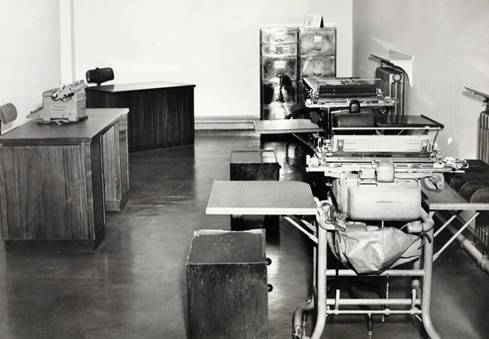
IN
THE MACHINE ROOM (2)
The
machine accounting equipment
|
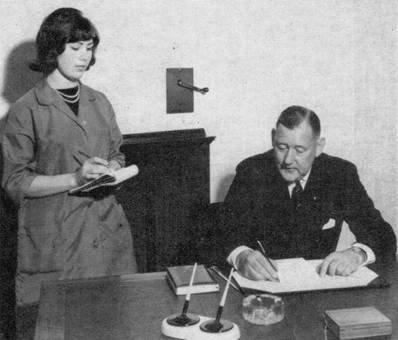
IN
THE MANAGER’S ROOM
Harold
Lawson (Manager) and Jill Austin
|
|
Three ladies complete the counter Staff:
Joyce Hill who worked at Brighton Branch until her family moved to Derby
eighteen months ago; Caroline Andrews who finds meeting customers far more
satisfying than shorthand and typing for British Rail where she worked
until a year ago; and Pamela Prowse, one of the two married ladies, and the
latest recruit to Derby Branch. She worked previously at Bedford and
Nottingham Branches. Jill Austin, manager's secretary,
lives at the village of Radbourne where her parents are farmers. Carol
Bayliss, who is married, and Valerie Winson are the machinists, and the
Branch's maid-of-all-work is Brenda Marshall, another recent recruit. A gold medallist in modern ballroom
dancing she teaches dancing at an evening institute. A man with fifteen years at
Derby Branch to his credit is Alf Leighton, the messenger. Mr Leighton, who
lives over the Branch, is a former professional soldier—an R.S.M. whose training is reflected in the impeccable neatness
of the Branch.Peter Ryder, who looks after foreign and securities work, was on
holiday when we called at the Branch. A late entrant from local government
he has lost no time in getting to grips with banking and attended a Domestic
Training Course in 1967. He came to Derby in 1966 from Charles Street
Branch, Leicester. What Derby Branch lacks in
tenpin bowling prowess it certainly makes up in a cheerful Staff, to say
nothing of some distinctive calendars…
Show Time…

|
|
 The Derby Daily Telegraph carries
an advertisement similar to this one, to advertise the Bank’s presence at
the Derbyshire Agricultural Show, on 15 June 1950. This particular ad, featuring the topic
of Farming and how the Bank has a long history of helpful the farming
community, is also used without any specific mention of a local show, to
advertise the Bank in National newspapers. It was common for the Bank to design “generic”
advertisements – those with a common theme, or the same image, but where
the text and other details can easily be changed to match a particular Branch,
service or event. The Derby Daily Telegraph carries
an advertisement similar to this one, to advertise the Bank’s presence at
the Derbyshire Agricultural Show, on 15 June 1950. This particular ad, featuring the topic
of Farming and how the Bank has a long history of helpful the farming
community, is also used without any specific mention of a local show, to
advertise the Bank in National newspapers. It was common for the Bank to design “generic”
advertisements – those with a common theme, or the same image, but where
the text and other details can easily be changed to match a particular Branch,
service or event.
Farewell Mr Gordon…
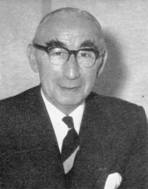
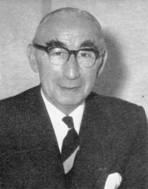 Mr. W. R. Gordon retired at
the end of September, after 45 years' service. On the evening
of Saturday, October 1st, he and Mrs. Gordon entertained, at The Coppice Hotel,
Littleover, a party of seventy which included present and former colleagues
and their wives, and a few close friends and relations. Mr. W. R. Gordon retired at
the end of September, after 45 years' service. On the evening
of Saturday, October 1st, he and Mrs. Gordon entertained, at The Coppice Hotel,
Littleover, a party of seventy which included present and former colleagues
and their wives, and a few close friends and relations.
|
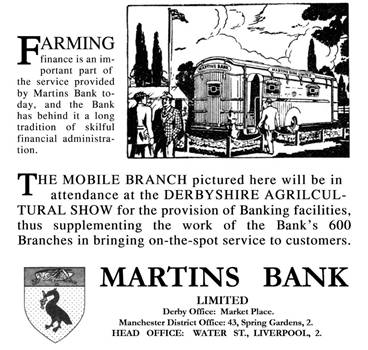
Image © Martins Bank Archive Collections
|
|
  Among the guests were Mr. D.
C. Bardsley, Midland District General Manager, Mr. R. J. Lees, Superintendent
of Branches, and Mr. Jack Wood, the retired Manager of Birmingham City
Office, who now resides in Eastbourne. Many others had travelled long
distances to be present. Mr. Bardsley spoke in the highest terms of 'Bill'
Gordon's service to the Bank, paying a special tribute to his undoubted
ability to train young men and mentioning that seven of his former second
men were now managers. He recalled his early days in the Lake District,
when at one time Mr. Gordon ran a 'Wells Fargo' service, visiting five
sub-Branches with a horse and trap until on one occasion this performance
was witnessed by the then General Manager with the result that he was
promoted to a taxi - believed to be the first used in the
service of the Bank. Among the guests were Mr. D.
C. Bardsley, Midland District General Manager, Mr. R. J. Lees, Superintendent
of Branches, and Mr. Jack Wood, the retired Manager of Birmingham City
Office, who now resides in Eastbourne. Many others had travelled long
distances to be present. Mr. Bardsley spoke in the highest terms of 'Bill'
Gordon's service to the Bank, paying a special tribute to his undoubted
ability to train young men and mentioning that seven of his former second
men were now managers. He recalled his early days in the Lake District,
when at one time Mr. Gordon ran a 'Wells Fargo' service, visiting five
sub-Branches with a horse and trap until on one occasion this performance
was witnessed by the then General Manager with the result that he was
promoted to a taxi - believed to be the first used in the
service of the Bank.
Mr. Bardsley, on behalf of present and
former colleagues, then made the presentation of a suitcase and said there
was also a motor-mower, which was being delivered to Mr. Gordon's home in
Derby where he will continue to reside. In a characteristic reply Mr. Gordon said that if you
lived with anything for 45 years you grew to love it and the Bank was no
exception, and that now that the time had come, he was sorry to retire. He
went on to thank all those who had worked with him for their unfailing
help, loyalty and friendship and said that his very last act in the Bank
had been to place his initials on a correspondence form which simply said
"Thank you" and which he thought was most appropriate as he had
much for which to be thankful.
A
bouquet was then presented to Mrs. Gordon by Miss Smith on behalf of the
ladies of the Branch. Mr. Gordon entered the Bank in 1915 at Windermere,
going to Kirkby Stephen the following year. He served with H.M.Forces from 1917-1919, afterwards resuming his Bank
service at Sedbergh. He subsequently saw service at Skipton, Colne, and at
East Branch in the Liverpool District in 1932. In 1933 he went to London
and in 1935 he returned to Liverpool, to South John Street. He was
appointed Manager at Liscard in 1938 and at Derby in 1946.
Local Training…
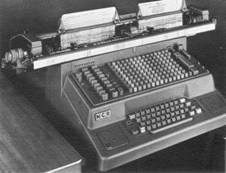
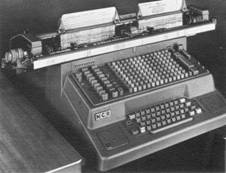 Derby Branch is also home to the Bank’s Midland District Machine
Schools. Martins has established
machine schools in several large towns and cities, to train the
book-keeping Staff to use the quite complicated forerunners to computerised
banking, such as the National 32 Machine shown here (Image ©NCR Ltd
1966). The courses take
place throughout the year, and the Bank uses Trainers from within its own
Staff to pass on their skills and knowledge to the students. One such Trainer is our good friend Iris
Brooks, who runs the training at Derby, and she kindly proivded us with
details for a feature about the work she was involved in at the Training
School. You can read about the
Midland District Machine Schools, including some of the original “joining
instructions” to the course candidates HERE – thejoys of second class travel and a tiny lunch allowance will be
familiar to bank staff everywhere! Derby Branch is also home to the Bank’s Midland District Machine
Schools. Martins has established
machine schools in several large towns and cities, to train the
book-keeping Staff to use the quite complicated forerunners to computerised
banking, such as the National 32 Machine shown here (Image ©NCR Ltd
1966). The courses take
place throughout the year, and the Bank uses Trainers from within its own
Staff to pass on their skills and knowledge to the students. One such Trainer is our good friend Iris
Brooks, who runs the training at Derby, and she kindly proivded us with
details for a feature about the work she was involved in at the Training
School. You can read about the
Midland District Machine Schools, including some of the original “joining
instructions” to the course candidates HERE – thejoys of second class travel and a tiny lunch allowance will be
familiar to bank staff everywhere!

|
|
|
|
|
|